Context bundlerules · body card: frames, axes, offsets · task, verbatim · success, in plain language · tool manual: schemas. Never simulator state or the success check’s code.
Context managementlatest 6 exchanges in full · older results and images become references, reopened with artifact_read · closed episodes summarized · a checkpoint as the last resort.
Tools, with a terminala Python library in a persistent workspace: look, measure, act. One program per turn; each motion planned with cuRobo, or refused with a reason.
Observation, each turnthe program’s output, the camera images it asked for, a receipt per motion. Behind the trust boundary: simulator state and the success check.
01 · ORA · what it does
An open-weight model, zero-shot: 79.6% on RoboTwin, 39.9% on RoboDojo.
RoboDojo · by systemSame model, other agent systems
DeepSeek-V4.1-Flash throughout. Successes after the step limit count. Leaderboard: RoboDojo's harness, RGB only. *With a LIBERO-trained policy.
01 · ORA · prompt bundle
What does the model need to know?
EmbodimentFrames, axes, offsets.
EnvironmentCameras, workspace.
TaskVerbatim.
SuccessIn plain language.
ToolsSchemas.
The model never sees simulator state or the success check's code.
01 · ORA · prompt bundle · from a run
Embodiment cards, verbatim
ARX X5RoboDojo
Fixed-base ARX X5: left 6-DoF arm, right 6-DoF arm; parallel-jaw grippers. Cameras: head fixed RGB-D; left_wrist, right_wrist moving RGB-D.
Controlled point
wrist flange; add no offset
Success signal
the benchmark's reward manager
ALOHARoboTwin
Fixed-base ALOHA-AgileX: left 6-DoF arm, right 6-DoF arm; parallel-jaw grippers. right_tcp is the controlled reference, 0.12 m from the flange; commands already target it.
Controlled point
tool point 0.12 m beyond the flange
Success signal
the task's check_success
FrankaLIBERO / LIBERO-Pro
Fixed-base Franka Panda: right 7-DoF arm; parallel-jaw grippers. right_grip_site is the controlled reference, 0.097 m from the end-effector root; commands already target it.
Each tile: a move that went wrong before; switch it to the same request on v0.1.
ORA blog, Section 2. cuRobo; TOPP-RA, Ruckig.
01 · ORA · solved tasks
01 · ORA · six open models
Study over different models
01 · ORA · harness and training
Relationship between training and harness
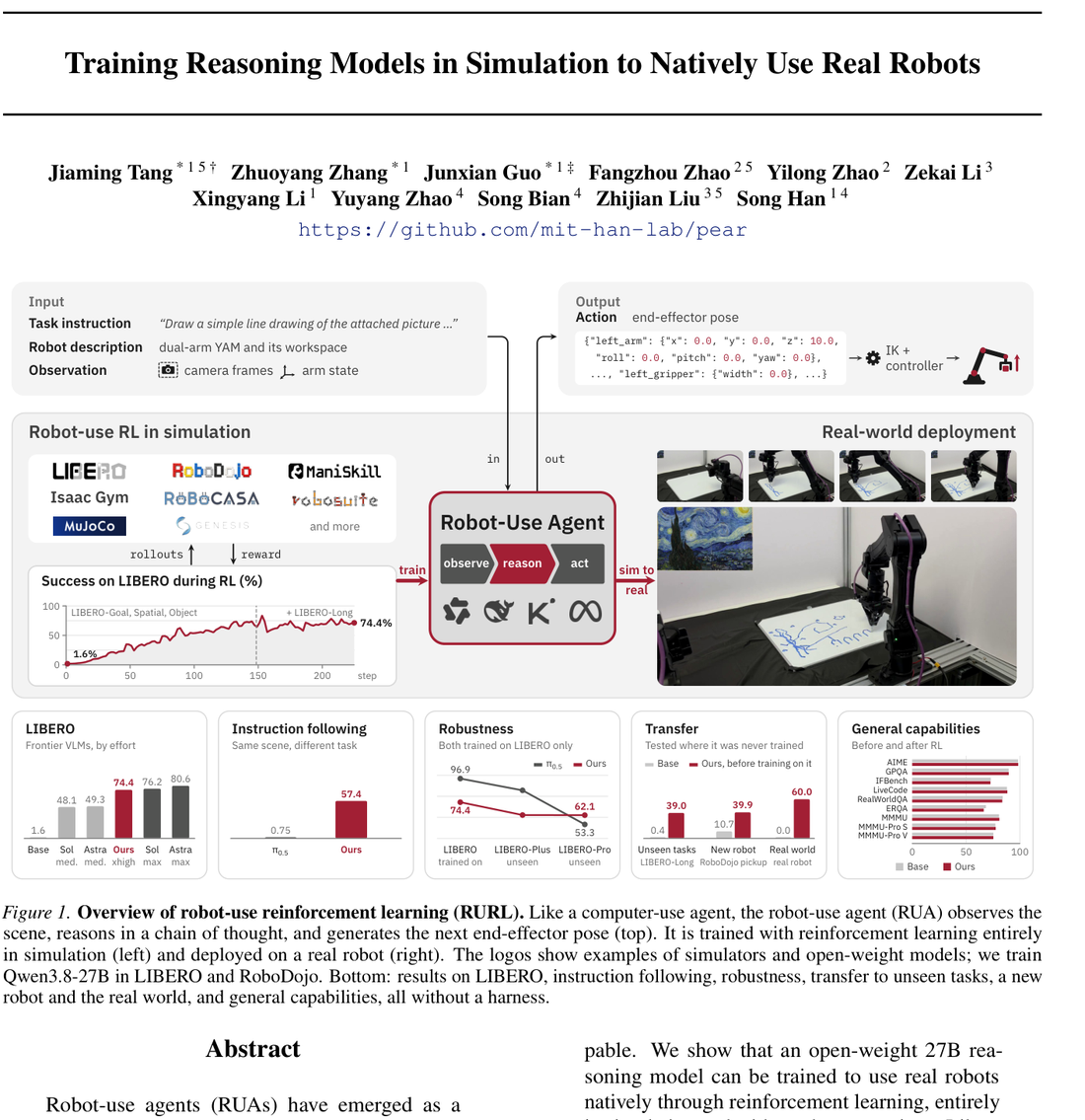
PEARNovember 2026
PEAR, arXiv:2611.18562. Scored within the step limit, as PEAR does.
Two works
ORA: Open Robot-Use AgentsCan a language-model agent run a robot? How to build one, zero-shot, into the physical world.
FastRUA: Toward Real-Time Robot-Use Agents
02 · Toward real time
Why does speed matter?
Claude Fable 5.2 · Anthropic
60×
Shown at 60×, pauses cut.
GPT-6 Astra · NVIDIA ASPIRE
320×
Shown at 320×.
Every demo is sped up. Real time: the same agent, watchable at 1×.
02 · Real time
How to get started
Our starting point. Every gap in the robot lane is a bubble: the arm waits on the model.
Toward Real-time RUA: the cup task, the vanilla loop modelled from the real run's measured costs (667 s, 164 model requests). From the post's video.
02 · Real time · 1 of 4
Fewer round trips
The action runs as soon as it is written; the look comes back with the result, not in requests of its own.
Toward Real-time RUA, Figure 5 (illustrative).
02 · Real time · 2 of 4
Shorter context
Every image left in the context adds to TTFT on every later request; past about 20, old images become short notes.
Toward Real-time RUA, Figure 7.
02 · Real time · 3 of 4
Faster tools
One Python process for the whole run: no start-up on each call, and what the agent defined stays defined.
Toward Real-time RUA, Figure 9.
02 · Real time · 4 of 4
Pipelining
The model writes the next action while the arm runs this one: its time hides behind motion. Cup task: 367 s to 204 s.
Toward Real-time RUA, Figure 10; Figure 14 for the times.
02 · Real time
All four, on one time axis
Toward Real-time RUA, Figure 12. The top two rows are replays of the real run.
02 · Real time
How much faster?
The same cup task as each design is added · wall time
Toward Real-time RUA, Figure 14. One real run with the full harness, replayed without each design at the measured costs; only the last bar is the real run.
02 · Real time
How close to real time?
6min
Towel fold, medianwas about 18
84%
Robot movingcup task
5s
From what it saw to its next actionmedian, about
Folding a towel · spread a partly folded towel, fold it in half · 2.5×, the agent and robot lanes below
Toward Real-time RUA, Results. Finished towel runs: full harness against the earlier versions (16 to 18 min).
 NICE · 28 November 2026


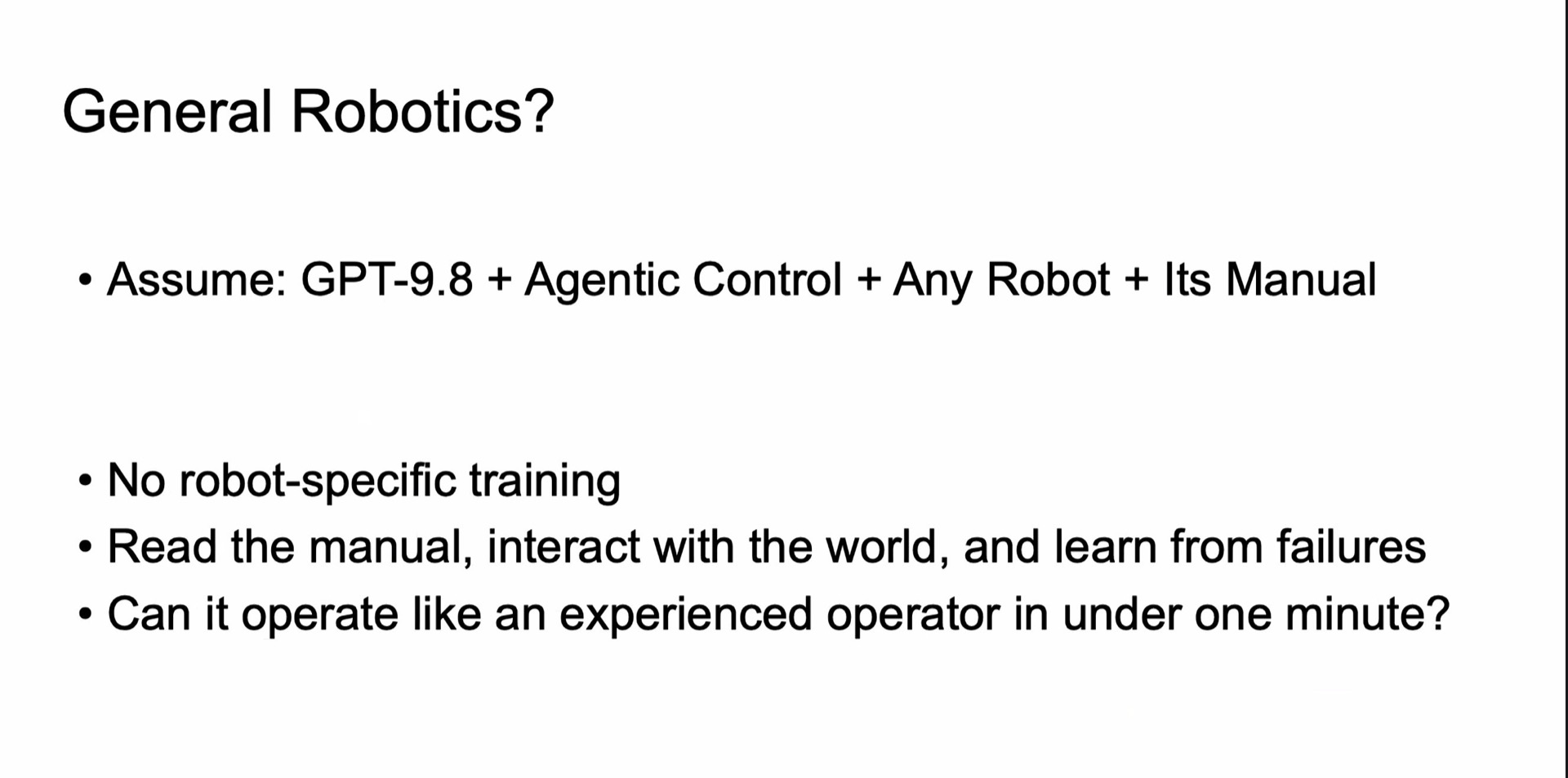

 A robot-use agent: the same loop, around a robot
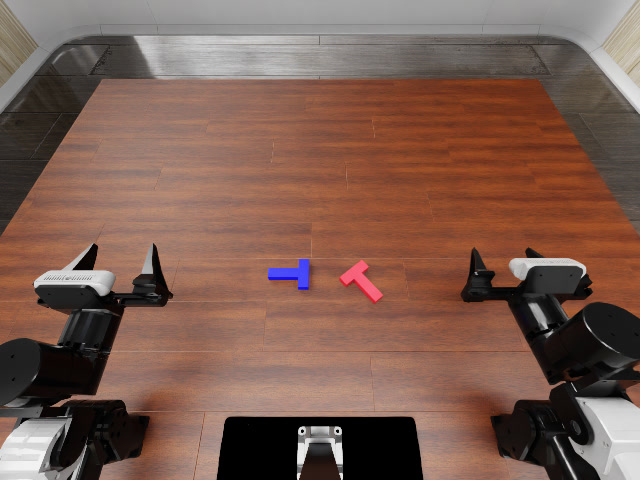 ARX X5RoboDojo · two arms
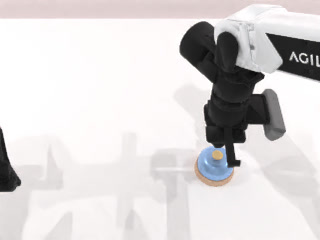 ALOHARoboTwin · two arms
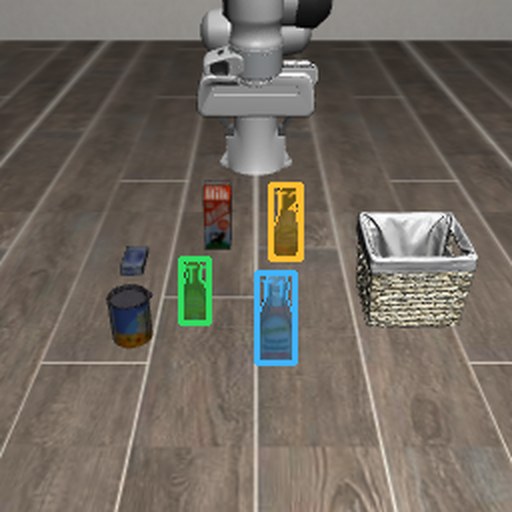
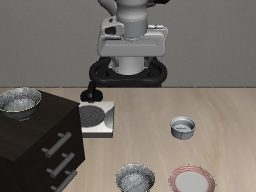 FrankaLIBERO · one armsuccess checkcode hidden from the model
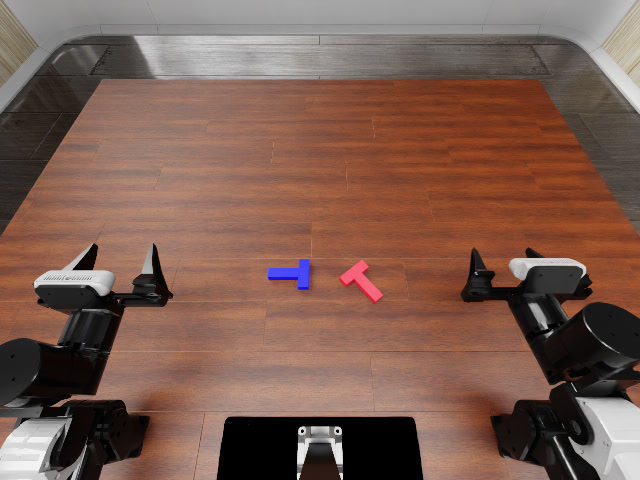 ARX X5RoboDojo
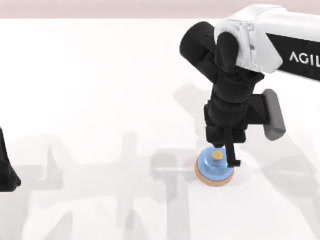 ALOHARoboTwin
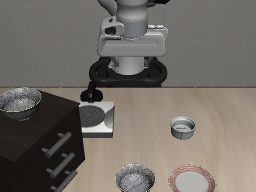 FrankaLIBERO / LIBERO-Pro
 Yuanbo YangUCSD
 Shaoxiong DuanUCSD
 Quanquan PengUCSD
 Junda ChenUCSD
 Yulun WuUCSD
 Siyi ChenUMich
 Zhaoning WangUMich
 Jun GaoUMich
 Hao ZhangUCSD